



Greetings from Yecla: where wine, prehistory and furniture meet
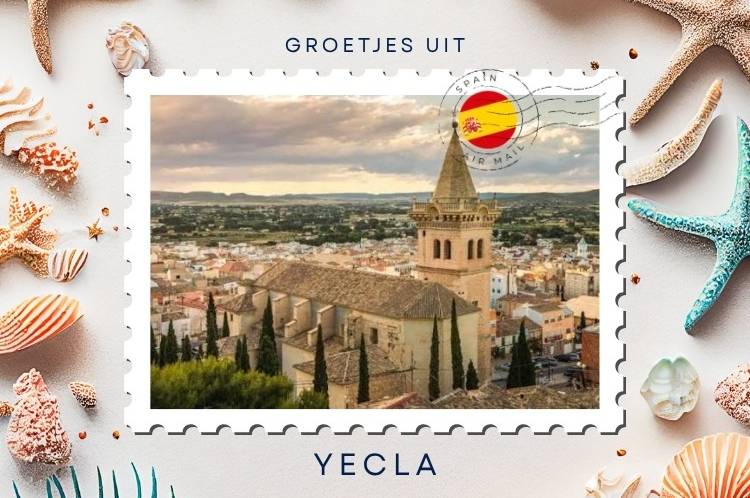
Greetings from Yecla: where wine, prehistory and furniture meet
Yecla reveals a side of the Region of Murcia that bears little resemblance to the familiar Mediterranean coastline. The town lies in the far north of the region, among vineyards, high plains and mountain ranges, close to the borders with Alicante and Albacete provinces. There is no seafront promenade or marina here. Yecla is first and foremost a working Spanish town whose economy has long been connected with wine, agriculture and an unexpectedly important furniture industry.
Its history also reaches back thousands of years. Monte Arabí contains prehistoric rock art, the remains of Islamic Yakka overlook the modern town and the centre combines Renaissance and Baroque buildings with the distinctive blue-and-white dome of the Basílica de la Purísima. Anyone considering this area can also explore our page about living and buying property in Yecla.
From prehistoric settlement to Islamic Yakka
Yecla's history began long before the modern town. The municipal archaeological museum divides its permanent exhibition between the prehistory of Monte Arabí, protohistory, Romanisation and the medieval period, illustrating the unusually rich archaeological record of the municipality.
During Islamic rule a fortified hisn was established on Cerro del Castillo and a small settlement known in Arabic sources as Yakka developed below it.
Following the Castilian conquest in the mid-thirteenth century, a new Christian settlement grew on the northern slope of the hill. Yecla then expanded particularly rapidly during the sixteenth century.
That history is still visible in the street plan: the oldest upper neighbourhoods are narrow and irregular, while later expansions are considerably straighter and more spacious.
Monte Arabí: archaeology in a remarkable landscape
Around fifteen kilometres from the town is Monte Arabí, one of Yecla's most distinctive natural and archaeological areas.
Erosion has carved cavities, shelters and honeycomb-like surfaces into the rock. Several important archaeological sites are scattered through this unusual landscape, including Cantos de Visera, Cueva del Mediodía and El Arabilejo.
At Cantos de Visera, dozens of painted figures survive in two rock shelters. Bulls, horses, deer and goats appear alongside more schematic signs. Cueva del Mediodía contains further groups of prehistoric paintings.
Cantos de Visera has formed part of the UNESCO World Heritage property Rock Art of the Mediterranean Basin on the Iberian Peninsula since 1998. This does not mean that the entire mountain is a separate UNESCO World Heritage Site; the paintings belong to a much larger collection of sites spread across eastern Spain.
Access to the paintings themselves requires advance reservation and an accompanying guide. The general Monte Arabí walking route is approximately 5.5 kilometres and is rated medium-low in difficulty.
Rock carvings and treasure legends
Near El Arabilejo are the cazoletas, cup-like carvings cut into exposed rock and interpreted in local archaeological material as part of schematic rock art.
Cueva del Tesoro provides a more folkloric story. Local legend tells of mysterious men who entered the cave in the nineteenth century and later returned carrying sacks, rewarding nearby farmers with gold coins. It is a legend rather than documented history, but it shows how deeply Monte Arabí has entered local imagination.
The Old Church
The Parroquia de la Asunción, usually called the Iglesia Vieja or Old Church, was begun in 1512 and completed roughly forty years later. Its architecture combines a Gothic nave with Renaissance elements and it was declared a national historic-artistic monument in 1982.
Yecla Tourism currently lists the interior as temporarily closed for restoration work, so anyone planning a visit should check the latest information.
From the nearby viewpoint, the contrast between its historic tower and the enormous striped dome of the much later Basílica de la Purísima is one of the town's most recognisable views.
The blue-and-white dome of the Basílica de la Purísima
The first stone of the Basílica de la Purísima was laid in 1775. Construction stopped in 1793, resumed in 1859 and was finally completed in November 1868.
Its defining feature is the large elevated dome covered in glazed blue-and-white tiles arranged in spiralling bands. Inside, twentieth-century murals by Lorca-born painter Manuel Muñoz Barberán decorate the building.
The church also experienced a difficult twentieth century. A major fire in 1936 destroyed much of its interior heritage and extensive restoration took place between 1940 and 1954.
Plaza Mayor and an expanding town
Plaza Mayor is one of the best places to understand Yecla's civic history. Around it are the Town Hall, Palacio del Concejo, Palacio de Alarcos and the former Pósito or grain store.
During the eighteenth century, agricultural expansion brought another period of population and urban growth. Straighter, broader streets and substantial town houses appeared beside the older medieval neighbourhoods.
Modern Yecla therefore contains several very distinct urban layers rather than one uniform historic centre.
A wine appellation contained within one municipality
The Yecla Denomination of Origin was established in 1975 and has an unusual geographical characteristic: its protected area consists of the single municipality of Yecla.
Vineyards generally stand between around 535 and 800 metres above sea level in a transition zone between Spain's central plateau and the Mediterranean southeast.
Monastrell is the dominant grape variety and accounts for roughly two thirds of the varietal distribution within the appellation. Yecla combines limestone soils, low rainfall, intense sunshine and significant temperature variations.
The Yecla Wine Route connects wineries, restaurants, accommodation and shops and organises wine-related activities throughout the year.
Winters are very different from the Murcia coast
Yecla's elevation and inland position produce a continentalised Mediterranean climate with hot summers and much colder winters than on the coast.
For permanent residents, this matters. Night-time winter temperatures can be low and occasional frost is normal, so insulation and heating deserve more attention than buyers accustomed to the Mar Menor or Costa Blanca may expect.
Yecla is not simply a lower-cost version of coastal Spain. The climate and lifestyle are fundamentally different.
Wine indirectly helped create the furniture town
Yecla's other major economic identity is furniture.
Woodworking trades existed for centuries, including carpenters, coopers and cabinetmakers. Local tourism history also connects later expansion of the industry with the nineteenth-century French phylloxera crisis. Rising French demand for Spanish wine encouraged vineyard expansion around Yecla, trees were cleared and the resulting supply of wood helped support local woodworking activity.
During the twentieth century, this craft base developed into a large industrial network including furniture manufacturing, upholstery, mattresses, transport and associated businesses.
Spain's oldest furniture trade fair
In 1961, fifteen furniture factories, two upholstery businesses and one veneer company organised Yecla's first local furniture exhibition.
The following year it became the Feria Provincial del Mueble e Industrias Afines, recognised as Spain's first sector-specific furniture fair.
The tradition continues. The 64th Yecla Furniture Fair took place from 26 to 29 May 2026, bringing together professionals from furniture, interiors and related sectors.
This industrial economy is one reason Yecla remains active throughout the year rather than depending on a tourist season.
December sounds like gunpowder
Yecla's Fiestas Patronales in honour of the Immaculate Conception are recognised as a Festival of International Tourist Interest.
Current regional information traces the tradition to 1642, when a company of Yecla men went to fight in the Catalan conflict and later returned safely from the garrison at Vinaroz. Religious thanksgiving eventually developed into the present celebrations surrounding the Virgen del Castillo.
Traditional arquebuses firing blank gunpowder charges, the Alborada, the Bajada, processions and flag ceremony transform the streets for several days. The official regional calendar lists the 2026 celebrations from 5 to 15 December.
For residents of the historic centre this means living culture on the doorstep, but also noise, crowds and temporary traffic changes.
San Isidro and extraordinary paper floats
Another major local celebration is San Isidro in May, closely connected with agriculture.
Its most unusual feature is the parade of elaborate floats covered in thousands of handmade paper decorations, alongside floral events, wine tastings and other festivities.
It is an excellent example of how Yecla's agricultural identity remains part of everyday culture rather than simply being presented to tourists.
Gazpacho here is not cold tomato soup
Yecla's food is distinctly inland.
Gazpacho yeclano is a substantial hot dish involving unleavened flatbread and traditionally ingredients such as rabbit and snails. The bread absorbs the stew and may later be eaten with honey or anchovies.
Other local foods include gachasmigas, meat-filled pelotas, fried cheese with tomato, potato empanadas and libricos, thin engraved wafers filled with honey or chocolate.
The cuisine reflects Yecla's position between Murcia, La Mancha and the Valencian interior.
Town living or a finca?
For buyers, the exact setting matters enormously.
Living in town
Yecla offers apartments, traditional town houses and detached homes, with schools, shops, restaurants and healthcare close at hand.
The historic hillside has steeper streets and more difficult parking, while newer districts are generally easier for vehicles and everyday access.
La Decarada and other outer residential areas
Around the edges of Yecla are more detached villas and larger plots. These offer privacy and space but make a car much more important.
Fincas and country homes
The surrounding countryside contains many detached rural homes among vineyards, olive groves and agricultural land.
Legal due diligence is particularly important here. The house, swimming pool, garages, stores and other structures should all correspond with official records. Water supply, electricity, wells, septic systems and legal access also deserve careful investigation.
A local hospital makes permanent living easier
Yecla has the infrastructure of a genuine regional centre.
Hospital Universitario Virgen del Castillo is located in the town and serves Health Area V Altiplano, covering Yecla and Jumilla. It includes emergency care, operating theatres, diagnostic facilities and specialist outpatient services.
Schools, municipal services, sports facilities and an urban bus network are also available locally.
Residents therefore do not need to travel to Murcia or Alicante for every normal everyday service.
Villena is important for rail connections
Murcia city is approximately 96 kilometres from Yecla and Alicante about 85 kilometres away.
The nearest conventional railway station and high-speed AVE station are around Villena, approximately 23-24 kilometres away.
Alicante Airport is roughly 85 kilometres from Yecla, while Región de Murcia International Airport is approximately 115 kilometres away.
For many international residents, Alicante can therefore be the more practical airport.
Yecla or Pinoso?
Both locations appeal to buyers looking for land, fincas, vineyards and a less tourism-oriented lifestyle.
Pinoso is smaller and lies in Alicante province. Yecla is larger and more industrial, with its own hospital and a particularly strong furniture economy.
Anyone wanting a self-contained town with extensive services may prefer Yecla, while buyers seeking a smaller community orientated more towards Alicante and the Costa Blanca may favour Pinoso.
Yecla or Jumilla?
Jumilla shares the Altiplano landscape and has an equally strong wine identity.
Yecla differs because furniture manufacturing has such a major influence on its economy. Its position close to Villena and Alicante also means that daily connections frequently extend across the regional boundary into the Valencian Community.
Buying property in Yecla
For an apartment, check owners' association costs, lift access, parking and the age and condition of the building. Traditional homes deserve careful review of past alterations and registry documentation.
For villas and fincas, boundaries, outbuildings, swimming pools, water, access and the legal status of every structure become particularly important.
Tourist letting should never be assumed either. Current regional, municipal and any applicable owners' association rules should be checked before purchasing specifically for that purpose.
Casas Palmeras therefore considers both the property and the kind of daily life the location will provide. You can read more about our working method.
A town that does not need tourism in order to function
That may ultimately be Yecla's most distinctive quality.
Factories open every morning, vineyards continue to produce, schools and the hospital operate throughout the year and the centre belongs first and foremost to its residents.
At the same time, a mountain containing UNESCO-recognised prehistoric paintings lies only a short drive away, while centuries-old gunpowder traditions transform the streets each December.
Those looking primarily for beaches and a large international community will probably prefer another part of Spain. Those wanting space, a genuinely Spanish daily environment, wine country and a self-contained working town may discover exactly what they were missing in Yecla.
Greetings from Yecla!