

Greetings from Estepona: flowers, history and life by the sea
Greetings from Estepona: flowers, history and life by the sea
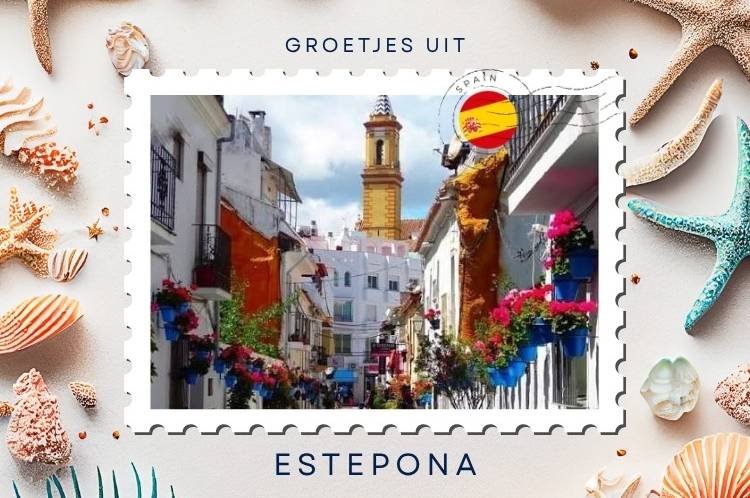
On the western Costa del Sol, between Marbella and Casares, lies Estepona. Its historic centre has undergone an enormous transformation, with pedestrian streets, white façades, coloured flowerpots and small plazas, while the seafront has gained new landscaped promenades and major cultural facilities.
Yet Estepona's history stretches back thousands of years. The municipality contains a 5,000-year-old megalithic cemetery, Phoenician and Roman remains, the medieval Islamic settlement of Estebbuna and a sixteenth-century coastal fortress. The modern old-town project has now renovated more than 130 streets, decorating them with thousands of plants and colourful pots.
Discover the Costa del Sol with Casas Palmeras
Five thousand years of history
One of Estepona's most remarkable sites is the Corominas Prehistoric Necropolis.
Archaeological excavations in 2001–2002 uncovered five exceptionally well-preserved megalithic tombs dating back approximately 5,000 years, together with later Bell Beaker burials.
Several dozen individuals were buried here with pottery, stone tools, arrowheads, axes, jewellery and pierced seashells.
The dolmens were moved
Because the site lay in the path of new infrastructure, the tombs were carefully relocated.
They are now displayed inside a purpose-built underground interpretation centre beneath an artificial burial mound in Los Pedregales. The original topography has been recreated and the five dolmens were returned to their relative original positions.
The result feels more like entering a prehistoric landscape than visiting a conventional museum.
The Venus of Estepona
Another important prehistoric object is the Venus de Estepona, a female figurine around five thousand years old discovered at Loma de la Alberica.
It forms part of the Archaeological Museum's collection.
The museum is currently officially listed as temporarily closed for renovation, so its status should be checked before visiting.
Phoenicians and Romans
Estepona's coastline formed part of important Mediterranean trading networks.
Numerous Phoenician and Roman sites have been identified. Archaeological remains near the Guadalmansa river mouth may have belonged to the Roman settlement of Salduba, although official tourism information presents this identification cautiously rather than as proven fact.
Roman villas and shipwrecks also demonstrate extensive activity along the coast.
Roman remains in the old town
In Calle Villa, visitors can see remains of a fourth-century Roman tower.
The current official walking route through central Estepona specifically includes the site.
It is a small archaeological detail hidden inside the modern city.
Estebbuna
The direct predecessor of modern Estepona developed during the 10th-century Caliphate of Córdoba.
The Islamic town was known as Estebbuna.
From the twelfth century onwards, the Andalusian medina experienced another prosperous period, reflected in archaeological material discovered beneath today's old centre.
The conquest of 1456
King Henry IV of Castile captured Estepona in 1456.
The settlement was subsequently largely destroyed. In the early sixteenth century, the Catholic Monarchs ordered the defences rebuilt and the strategic site repopulated, initially with around thirty families.
A new Christian settlement gradually developed.
San Luis Castle
The Castillo de San Luis was built during the final quarter of the sixteenth century.
Its role was to strengthen the southern side of the older walls and defend the natural anchorage at La Rada. The complex originally included three artillery bastions and a large military courtyard.
Later construction almost completely hid much of the fortress.
Recent archaeological work has reopened sections to visitors and revealed several historical phases of the site.
The Clock Tower survived an earthquake
The Torre del Reloj once belonged to the Church of Los Remedios.
The square tower was constructed in the sixteenth century and gained a Neoclassical bell section in the early eighteenth century. The devastating 1755 earthquake left the church in ruins and it was eventually demolished.
The tower survived.
A major mechanical clock installed in the early twentieth century still marks the hours today.
Independence from Marbella
Estepona remained administratively linked to Marbella for centuries.
In 1729, Philip V granted it the Privilegio de Villazgo, establishing independent municipal status.
From there, Estepona gradually developed into a substantial town in its own right.
Plaza de las Flores
Today's famous Plaza de las Flores largely belongs to Estepona's nineteenth-century eastward expansion.
Its name changed repeatedly over time according to political circumstances, including Plaza Nueva, Plaza de la Cárcel, Plaza de la Constitución and Plaza del Rey.
Today it is a pedestrian square surrounded by historic buildings, cafés and flowers.
Casa de las Tejerinas
The eighteenth-century Casa de las Tejerinas stands on the square.
It belonged to sisters Carmen and Francisca Tejerina, the latter eventually donating it to the Hospital de la Caridad.
Today it functions as a cultural venue and houses tourism services.
The Garden of the Costa del Sol
Estepona's renovated old town has become one of its strongest identities.
More than 130 streets have been improved and decorated with thousands of plants and colourful flowerpots.
Different streets often use different colour schemes.
The result encourages visitors to explore much more than one main shopping street.
Art across the city
The Artistic Mural Route has spread large-scale art through residential neighbourhoods as well.
The 2025 tourism brochure lists 48 murals across Estepona.
Together with sculpture and poetry routes, they have effectively turned parts of the city into a large open-air gallery.
The Orchid House
The Botanical Park and Orchid House is one of modern Estepona's most unusual attractions.
The greenhouse displays more than 4,000 orchids representing over 1,500 species, beneath three glass domes, the tallest rising roughly thirty metres.
Tropical plants, vertical gardens, ponds and waterfalls create a remarkable contrast with the white Andalusian streets outside.
More than 16,000 square metres
Together with the surrounding botanical park, the complex covers more than 16,000 m².
A large indoor waterfall and subtropical vegetation create an environment that feels far removed from the dry Mediterranean coast only minutes away.
Opening the city towards the sea
Large sections of Avenida España have also been transformed into a landscaped pedestrian boulevard with a cycle lane.
It connects central Estepona towards the Punta Doncella lighthouse and creates a much stronger relationship between the town and the Mediterranean.
Mirador del Carmen
At the western end sits the striking Mirador del Carmen complex.
It contains an eight-storey vertical library, conservatory, auditorium, exhibition space and panoramic viewing tower.
Its galleries have already hosted significant exhibitions associated with collections including Carmen Thyssen-Bornemisza and Fundación MAPFRE.
La Rada Beach
Estepona's main urban beach is Playa de la Rada, approximately 2,630 metres long.
It sits directly beside the centre.
That makes it unusually easy to combine normal town life with daily access to the Mediterranean.
More than 23 kilometres of coast
The municipality has over 23 kilometres of coastline and 17 beaches.
La Rada provides the main urban beach, while Playa del Cristo forms a smaller sheltered bay.
Further east are beaches and residential areas including El Padrón, Guadalmansa and El Saladillo.
The seafront promenade
Estepona's main promenade runs for roughly three kilometres beside La Rada towards the fishing harbour.
From there it connects with the wider coastal path.
For permanent residents, this is a major lifestyle asset rather than simply a tourist attraction.
More than twenty kilometres connected
Estepona's Senda Litoral project is now more than 90% complete, with over twenty kilometres of coastline connected by pedestrian paths.
A long continuous section already runs between Costa Natura and El Saladillo.
A working fishing harbour
Estepona still has an active fishing port.
Purse-seine boats return around sunrise after fishing through the night, while other fleets return later in the day and sell their catch through the fish market.
The harbour therefore retains a genuine working identity alongside tourism.
Virgen del Carmen
The Virgen del Carmen Coronada is Estepona's patron saint.
On 16 July, she is carried through the town and taken out to sea in a major maritime and land procession. In 2026, traditional swimming, rowing and fishing-related competitions took place at the harbour before the evening procession.
The event reveals Estepona's fishing identity more clearly than almost any other day of the year.
The main summer fair
The 2026 Feria y Fiestas Mayores ran from 7 to 12 July.
Free concerts, dance, children's events and equestrian traditions filled the programme.
The municipality estimated close to half a million visits during the six-day celebration.
Living in the historic centre
Estepona's old town is particularly attractive for anyone wanting a highly walkable lifestyle.
Restaurants, shops, the beach and promenade are all close.
Traditional townhouses and apartments dominate the market.
Parking and the physical condition of older buildings deserve particular attention.
Living beside La Rada
The immediate seafront has a large supply of apartments.
This is the obvious choice for anyone who wants the Mediterranean and town centre within a few minutes' walk.
For frontline property, we would always look carefully at salt exposure, wind, orientation, noise and long-term building maintenance.
A few streets inland can sometimes provide a better permanent-living balance.
The harbour and Playa del Cristo
Around the marina, fishing harbour and Playa del Cristo, Estepona takes on another character.
Apartments and villas extend westwards from the city.
The sheltered beach is particularly popular with families.
Western Estepona
Towards Bahía Dorada and Casares, development becomes less urban.
Residential complexes, villas and golf-related communities become more common.
Buyers can often gain more space and parking, but car dependence increases.
Eastern Estepona and the New Golden Mile
East of the city, the municipality continues for many kilometres towards Marbella.
A large number of modern developments are advertised as being on the New Golden Mile.
This is primarily a real-estate marketing term rather than an official administrative district with fixed boundaries.
Always check the property's exact location rather than relying on the label.
Cancelada
Cancelada is a distinct population centre within Estepona municipality.
Daily life there is much more closely connected with the eastern side of the municipality, San Pedro and Marbella than with central Estepona.
For commuters eastwards that can be an advantage.
For buyers dreaming of walking through Estepona old town every evening, it is a very different proposition.
One municipality, very different lifestyles
This is one of the most important points for property buyers.
Western areas orient towards Casares and Manilva.
Eastern areas can be closer to Marbella.
Central Estepona offers a genuinely urban, walkable lifestyle.
All may simply appear as “Estepona” on property portals.
Estepona or San Pedro de Alcántara?
San Pedro is more compact and closer to Puerto Banús and Marbella.
Estepona is larger and more independent, with its own substantial old town, marina, fishing harbour and a much longer municipal coastline.
Anyone whose daily life revolves around Marbella may prefer San Pedro.
Anyone wanting a self-contained coastal city may find Estepona stronger.
Estepona or Marbella?
Marbella has a more internationally famous luxury market and a greater concentration of high-end services.
Estepona has developed a different balance between traditional Spanish town life and modern luxury residential development.
For many buyers, that is precisely the attraction.
Buying property in Estepona
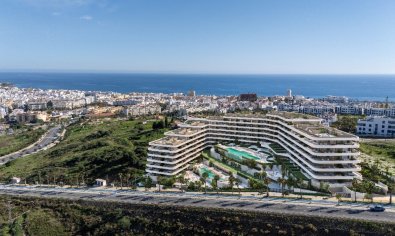
We would first choose the lifestyle zone: historic centre, La Rada, harbour and west, golf areas, or the eastern coast towards Marbella.
Then compare individual properties.
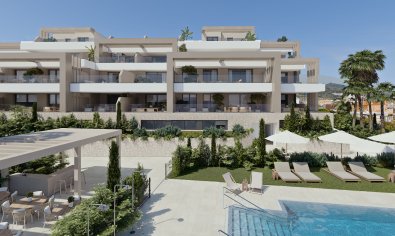
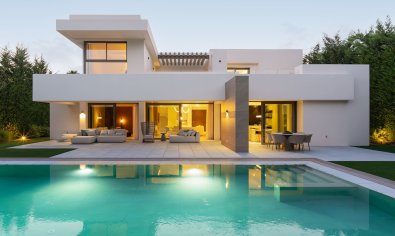
Apartment buyers should review community fees, parking, lifts and planned works. Villa buyers should also verify registration of the building, pool and extensions.
For new developments outside the centre, physically test the everyday journey to supermarkets, schools, beaches and the A-7.
A panoramic sea view does not tell you what Monday morning will be like.
Why Estepona is worth discovering
Start at Plaza de las Flores and explore the colourful streets without following too rigid a route.
Visit San Luis Castle and the Clock Tower before heading towards the Orchid House.
Continue to the seafront boulevard and the Mirador del Carmen, then walk on towards the fishing harbour.
If you have another morning, book a visit to the Corominas dolmens.
Few Costa del Sol towns offer so many historical layers within one municipality.
Five-thousand-year-old tombs, an Andalusian medina, a sixteenth-century fortress, flower-filled white streets, enormous murals, thousands of orchids, a working fishing harbour and more than 23 kilometres of Mediterranean coastline.
Greetings from Estepona!