

Greetings from Xàtiva: castle, Borgias and Spanish city life
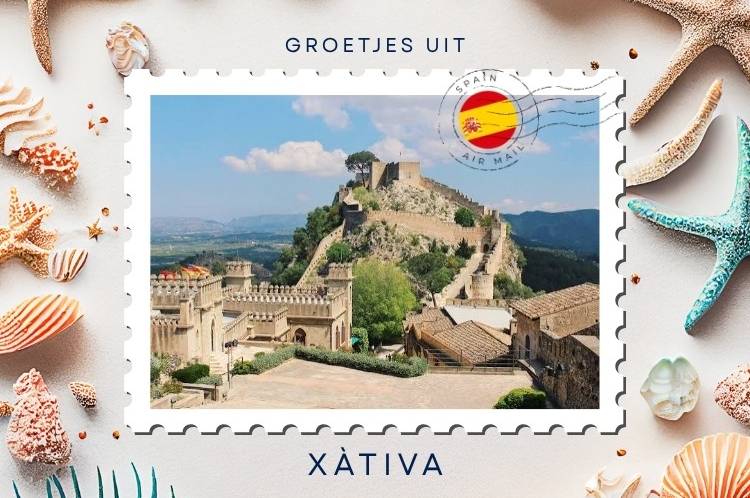
Greetings from Xàtiva: castle, Borgias and Spanish city life
Xàtiva lies inland in Valencia province beneath the Serra del Castell. Its enormous hilltop fortress dominates the skyline, while below it sits a compact historic centre shaped by Iberians, Romans, Visigoths, Muslims and Christians. Following the Christian conquest, Xàtiva eventually became the second city of the Kingdom of Valencia.
Yet this is not simply a heritage town. Xàtiva functions year-round as the regional centre of La Costera, with schools, healthcare, shops, restaurants and railway connections. The C2 Cercanías line provides a direct connection with Valencia.
Two castles rather than one
The great landmark is Xàtiva Castle.
The long fortress is actually divided into the Castell Menor and Castell Major. The smaller castle occupies Iberian and Roman foundations, while the larger section developed principally through Islamic and Christian medieval periods.
Its strategic position made Xàtiva a key military point for centuries.
Castell Menor and Hannibal
The older Castell Menor overlooks the Bixquert valley.
Local legends connect this part of the fortress with Himilce, the Iberian princess who married Hannibal, and with the Carthaginian general's campaigns. The so-called Hannibal Gate survives as part of the visitor route, although the present structure is medieval rather than Carthaginian.
Xàtiva is therefore one of those places where genuine archaeology and much later historical legends overlap.
Castell Major
The Castell Major is larger and better preserved.
Following Jaume I's conquest, it became a vital fortress protecting the route between Castile and the capital of the Kingdom of Valencia. Gates, towers, cisterns, chapels and former prison cells reveal the many different functions it performed over the centuries.
The views alone justify spending several hours on the castle hill.
Sant Feliu
Below the fortress is Sant Feliu Church, built in 1265 over the remains of the former Visigothic cathedral.
Its external gallery is supported by six reused Roman marble columns, while the interior contains an impressive early fifteenth-century Gothic altarpiece with 27 painted panels.
Roman, Visigothic and medieval Christian history therefore meet within the same building.
La Seu
The other major feature of Xàtiva's skyline is the Collegiate Basilica of Santa María, normally called La Seu.
Construction began in the late sixteenth century on the site of the former mosque and continued for more than four centuries. Even today the building is considered unfinished.
The extraordinary construction period created a local saying for anything that seems endless: “it lasts longer than the building of La Seu.”
Birthplace of the Borgias
Xàtiva was the birthplace of one of Renaissance Europe's most famous families: the Borja, or Borgias.
Alfons de Borja became Pope Callixtus III, while his nephew Roderic de Borja later became Alexander VI. Their political and religious influence spread far beyond Valencia and gave rise to centuries of stories about intrigue, power and nepotism.
Today Xàtiva is one of the essential stops on the Borgia Route.
Alexander VI was born here
The historic centre includes the traditional birthplace of Alexander VI.
Roderic de Borja was baptised in Sant Pere Church in 1432. Borgia coats of arms also survive around the city and La Seu's museum preserves objects including the chalice associated with Callixtus III.
Following the Borgia trail provides an excellent route through the old town itself.
The king who hangs upside down
Xàtiva's most recognisable museum exhibit, however, belongs to Philip V.
During the War of the Spanish Succession, Xàtiva supported the Habsburg claimant. Bourbon forces conquered the city in 1707, after which it was looted, burned and subjected to severe punishment. Its historic name was even replaced by Colonia Nueva de San Felipe until 1811.
That has not been forgotten.
Three centuries of symbolic revenge
A portrait of Philip V by local painter Josep Amorós hangs upside down in Xàtiva's Fine Arts Museum.
The painting was deliberately inverted during the twentieth century as symbolic revenge for the king's treatment of the city and has since become one of Xàtiva's defining images.
Residents are still nicknamed socarrats, meaning something close to “the scorched ones”, in reference to the burning of 1707.
More than three centuries later, Philip V is apparently still not forgiven.
Fine Arts Museum
The museum is worth visiting for much more than the inverted portrait.
Its collection includes works connected with Ribera, Goya, Vicente López, Santiago Rusiñol, Benlliure and Antoni Miró, among others.
José de Ribera, internationally known as Lo Spagnoletto, was himself born in Xàtiva.
The Almodí Museum
For the deeper history of the city, visit the Almodí Museum.
It occupies the former wheat market completed in 1548, with its Gothic façade and Renaissance courtyard. Archaeological exhibits range from the Palaeolithic through Iberian, Roman, Visigothic and Islamic Xàtiva.
Its outstanding object is an elaborately carved eleventh-century Islamic stone basin made from local pink marble.
One of Europe's earliest paper industries
Islamic Xàtiva experienced a major period of prosperity.
Its irrigation network was developed and a paper industry regarded by the local museum as the first in Europe became established here.
Paper-making knowledge had travelled west through the Islamic world and Xàtiva became one of its important European centres.
It is a fascinating chapter that receives far less attention than the castle or Borgias.
Neanderthals at Cova Negra
Only a short distance from modern Xàtiva is the Cova Negra nature area beside the Albaida River.
The protected landscape covers around 57 hectares and contains an archaeological cave of major importance for understanding Middle Palaeolithic Neanderthal life.
A replica of a Neanderthal skull fragment discovered during early excavations can be seen in the Almodí Museum.
Walking there from the city
The PR-V 78 trail begins near the Fuente de los 25 Caños and heads towards Cova Negra.
The tourist office estimates around one and a half to two hours on foot from Xàtiva, following much of the historic water channel.
Riverside woodland, Mediterranean vegetation and the large climbing wall at L'Aventador make this one of the best nearby outdoor excursions.
A medieval aqueduct
The route also reaches Les Arcadetes d'Alboi.
This historic aqueduct has nine pointed arches and stretches for approximately 200 metres. It formed part of the medieval Bellús-to-Xàtiva water system.
Water, in fact, is one of the recurring themes of Xàtiva's history.
The city of a thousand fountains
Xàtiva was once known as the city of a thousand fountains.
During the seventeenth century there were reportedly more than 900 water outlets throughout the city. They included monumental royal fountains, neighbourhood fountains maintained collectively and a smaller number of private ones.
A dedicated Water Route now links several surviving fountains with the historic centre.
An August fair dating from 1250
The Fira d'Agost is among Xàtiva's greatest traditions.
Jaume I granted the city the royal privilege to hold the fair in 1250, making it one of Spain's oldest surviving fairs. Livestock trading was originally the principal purpose, while today's event combines commerce, fairground rides, culture, sport, food and music.
It is traditionally held from 15 to 20 August.
Edition number 776
In 2026, Xàtiva celebrated its 776th Fira.
More than 200 exhibitors and 26 rides filled the main fair area, with theatre, music and family events across the city.
Despite weather disruption to several activities, thousands of people again attended the festival.
Few living local traditions can claim such a long continuous history.
Corpus Christi
Xàtiva's Corpus Christi procession is another highly distinctive tradition.
Giants, dwarfs, traditional dancers, horses, biblical characters, La Magrana and La Moma all appear in the procession.
Schools, dance groups, musicians and local associations all take part, making the tradition strongly community-based rather than simply a visitor attraction.
Arròs al forn
Xàtiva's signature dish is arròs al forn, oven-baked rice.
Traditionally prepared in a clay casserole, it commonly includes chickpeas, pork, morcilla, garlic, potatoes and tomato. Families once carried their casserole dishes to communal wood-fired ovens, giving the recipe the nickname arròs passejat, or “walked rice”.
If we had one lunch in Xàtiva, this is what we would order.
Arnadí
The classic local dessert is arnadí.
Pumpkin and almonds form the basis of a sweet whose Andalusian origins are still evident. Its distinctive pointed shape even recalls a North African tagine.
Another traditional sweet is almoixàvena.
Together they demonstrate how deeply Islamic culinary influence remains embedded in local food.
Easy access to Valencia
The railway station is only around ten minutes' walk from the historic centre.
The C2 Cercanías line connects Xàtiva directly with Valencia, while other regional services provide additional connections.
By road, the A-7 also makes Valencia and Alicante relatively easy to reach.
That gives Xàtiva a practical advantage over many smaller inland towns.
Living in Xàtiva
Xàtiva offers a useful middle ground between a large city and a small Spanish town.
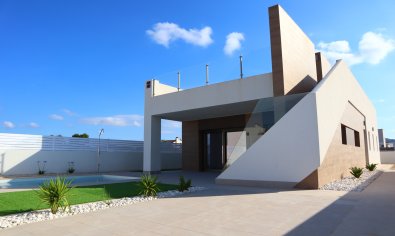
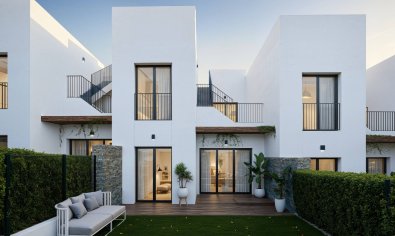
The centre contains apartments, traditional houses and historic properties, while newer residential districts provide a more conventional modern environment.
For detached homes and larger plots, Bixquert is particularly important.
Bixquert
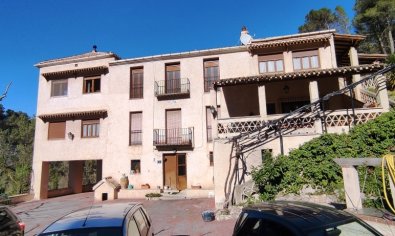
The green Bixquert valley lies beyond the castle.
The municipality described it in 2026 as a residential area with around 1,278 permanent residents.
Detached houses, gardens and larger plots are far more common here than in the city centre.
This creates a very different property choice while remaining close to Xàtiva.
Centre or Bixquert?
Central Xàtiva makes shops, restaurants, schools and the railway easier to reach on foot.
Bixquert provides greater privacy, natural surroundings and space, but a car becomes much more important.
Anyone considering a permanent move should therefore explore both before deciding what type of property to view.
Buying older or rural property
Historic architecture naturally comes with additional considerations.
For older town houses, building condition, roofing, moisture, installations and heritage restrictions may be relevant. Apartment buyers should look closely at communal building condition, lifts and future community works.
For detached or rural property, land classification and the legal status of pools, extensions and outbuildings require particularly careful checks.
Moving to Xàtiva
For anyone moving to Spain who prefers genuine Spanish and Valencian daily life to an international coastal development, Xàtiva is worth considering.
Valencian is widely used and local festivals, associations and family life remain very visible.
At the same time, the city provides far more everyday services and transport links than many small inland communities.
Its direct train link also keeps Valencia within practical reach.
And what about the beach?
Xàtiva is unmistakably inland.
This is not the choice for someone who wants to walk from home to the Mediterranean every morning.
Gandía and the Costa Valencia beaches are reachable for days out, while Valencia lies in the opposite direction.
The appeal here is history, city life, nature, space and connectivity rather than living directly beside the sea.
Why Xàtiva is worth discovering
Start early at the castle and explore both Castell Menor and Castell Major.
Walk down past Sant Feliu to La Seu, then follow part of the Borgia Route before visiting the Fine Arts Museum to see Philip V still hanging upside down.
Have arròs al forn and arnadí for lunch.
Save another morning for the walk from the 25-spout fountain towards Cova Negra.
And if you can visit in mid-August, the centuries-old Fira will show you a completely different side of the city.
Two castles, two Borgia popes, Neanderthals, hundreds of fountains, a fair dating from 1250 and a king whom Xàtiva still refuses to hang the right way up.
Greetings from Xàtiva!