

Greetings from Lorca: castle, embroidery and Spanish city life
Greetings from Lorca: castle, embroidery and Spanish city life
Lorca lies in the southwest of the Murcia region in the Guadalentín Valley. Although the city itself is inland, the municipality stretches all the way to the Mediterranean. Covering around 1,675 km², Lorca is the largest municipality in Murcia and the second largest in Spain by area.
That extraordinary size means Lorca combines a substantial Spanish city, dozens of rural communities, farmland, mountains and even Mediterranean beaches.
From Eliocroca to Lurqa
Roman Lorca was known as Eliocroca and occupied a strategic position on the Via Augusta.
Agriculture, livestock, commerce and travellers passing through the region supported the settlement.
During Islamic rule, Lurqa became an important city within the territory of Tudmir.
The fortified hill above the modern city still tells much of this story.
Lorca Castle
The enormous Castle of Lorca, now promoted as the Fortaleza del Sol, developed principally between the eleventh and thirteenth centuries.
For centuries it guarded the strategically important frontier between Murcia and the Nasrid Kingdom of Granada. It was even reused for defence during the Peninsular War.
Towers, cisterns and archaeological remains can all be explored within the walls.
Alfonsina Tower
The imposing Torre Alfonsina was commissioned by Alfonso X.
Approximately 31 metres high, it was designed to dominate the valley visually and demonstrate Castilian power along the Granada frontier. It remained an important symbol of Castile for more than 250 years.
The rooftop provides extensive views across Lorca and the Guadalentín Valley.
A Jewish quarter inside the fortress
Archaeological excavation uncovered a remarkable medieval Jewish quarter within the castle, including houses and a fifteenth-century synagogue.
The synagogue is particularly important because it was never converted into a Christian church after the Jewish community disappeared.
More than 2,600 glass fragments discovered around the bimah allowed archaeologists to reconstruct 27 lamps that once illuminated the synagogue.
Three cultures on one hill
Muslim fortifications, Christian towers and Jewish archaeology coexist within the same fortress.
That heritage is also remembered during Lorca's San Clemente celebrations, when Christian, Muslim and Jewish groups recreate aspects of the medieval frontier city.
It is one of the clearest examples of Lorca's complex cultural history.
Plaza de España and San Patricio
Back in the historic centre, Plaza de España provides a natural starting point.
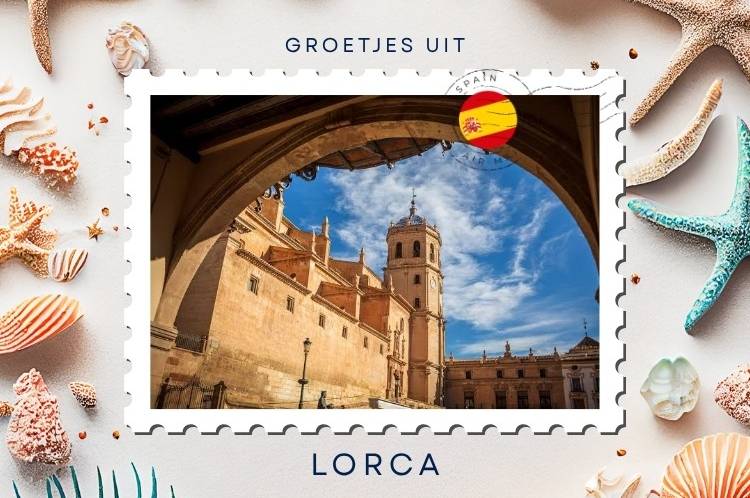
The former Collegiate Church of San Patricio was constructed between 1536 and 1780 and has a strongly Renaissance character.
Its dedication to the Irish saint has a surprisingly local explanation.
On St Patrick's Day, 17 March 1452, Lorca's forces defeated troops from Granada at the Battle of Los Alporchones. The church was subsequently dedicated to San Patricio in commemoration.
Guevara Palace
The Palacio de Guevara, completed in 1705, is one of Lorca's finest examples of civil Baroque architecture.
Its elaborate façade includes twisted Solomonic columns and extensive family heraldry. Inside, the house-museum retains furniture, paintings and lighting from the eighteenth to twentieth centuries.
The marble-columned courtyard is another highlight.
The 2011 earthquakes
Modern Lorca was profoundly affected by the earthquakes of 11 May 2011.
Two significant shocks measured magnitude 4.5 and 5.1, with the second epicentre only around two kilometres northeast of the city centre.
Nine people died and more than 320 were injured. Historic buildings, homes and sections of the castle also suffered extensive damage.
A huge reconstruction programme followed, restoring much of Lorca's historic heritage.
A completely different Holy Week
Lorca's Semana Santa has held International Tourist Interest status since 2007.
Its famous Biblical-Passion parades are unlike conventional Spanish Easter processions. Thousands of participants, horses, chariots, Roman soldiers, Egyptian characters, emperors and figures from the Old and New Testaments fill the main avenue.
At times it feels more like a vast historical production than a traditional religious parade.
White versus blue
The two largest brotherhoods are Paso Blanco and Paso Azul.
Their supporters occupy opposing sections of the parade route, cheering enthusiastically for their own colours and religious images. This rivalry is an essential part of Lorca's Holy Week atmosphere.
Yet some of the greatest treasures are not the horses or chariots, but the embroidery.
Silk and gold embroidery
Lorca has developed an extraordinary tradition of hand embroidery in silk and gold.
Robes, banners and cloaks can contain detailed portraits and complete historical scenes. The twelve first textiles in Spain to receive Bien de Interés Cultural protection are all preserved in Lorca, divided between Paso Blanco and Paso Azul.
Lorca embroidery is currently also an official candidate for UNESCO Intangible Cultural Heritage status.
The MUBBLA and MASS museums allow visitors to appreciate the craftsmanship throughout the year.
San Clemente
November brings the San Clemente festivities, recognised as a festival of Regional Tourist Interest since 1995.
San Clemente is Lorca's patron saint and his principal day is 23 November. Medieval Christian, Muslim and Jewish groups recreate episodes from Lorca's frontier history.
In 2026 the celebrations run from 8 to 27 November.
Virgen de las Huertas
Lorca's patroness is Santa María la Real de las Huertas.
The traditional Feria Chica is held around her sanctuary. In 2026 the programme runs from 30 August to 8 September and includes a flower offering, serenade, procession and international folklore festival.
The city's larger September fair follows later in the month.
Yes, Lorca really has beaches
One of Lorca's greatest surprises is its coastline.
The enormous municipality includes approximately 11 kilometres of largely undeveloped Mediterranean shoreline with 14 beaches and coves.
They are concentrated around Ramonete, Puntas de Calnegre and Garrobillo, much of it within or beside the protected Cabo Cope and Puntas de Calnegre landscape.
Cala de Calnegre is among the best known and currently holds Blue Flag recognition.
An enormous municipality
Lorca includes 39 population centres spread across roughly 1,675 km².
A Lorca address can therefore mean a city-centre apartment, a village house, a rural finca or a property many kilometres from the urban centre.
Exact location matters enormously when comparing homes.
Living in Lorca
Lorca is a genuine year-round regional city rather than a seasonal resort.
Urban neighbourhoods provide apartments and townhouses close to everyday facilities, while the surrounding districts offer detached houses, country properties and large plots.
For buyers who want more land and Spanish daily life rather than immediate access to a tourist beach, the wider municipality can offer a very different property market.
Buying property in Lorca
The first decision should be city or countryside.
Urban Lorca provides easier access to shops, schools, restaurants and daily services. Rural Lorca offers space and privacy, but distances are much greater and a car becomes essential.
For fincas and country homes, land classification and the legal registration of the house, pool, garages and outbuildings should always be checked carefully.
Lorca or Águilas?
Nearby Águilas offers a much more directly coastal lifestyle, with beaches and the Mediterranean shaping everyday life.
Lorca is the stronger option for those who prefer a substantial inland city, historic architecture and a much larger choice of rural surroundings.
Both provide genuine year-round Spanish life but in very different settings.
Why Lorca is worth discovering
Begin at the castle with the Alfonsina Tower and remarkable medieval synagogue.
Then descend into the historic centre for Plaza de España, San Patricio and Guevara Palace. Make time for at least one embroidery museum, because Lorca's silk-and-gold tradition is essential to understanding the city.
On another day, leave the urban centre behind and explore the Guadalentín farmland, rural communities and eventually the natural coastline around Calnegre.
A medieval frontier fortress, hidden synagogue, Baroque palaces, horses and gold embroidery at Easter — all within a municipality that stretches to the Mediterranean.
Greetings from Lorca!