


Greetings from Mazarrón: beaches, mines and Mediterranean life
Greetings from Mazarrón: beaches, mines and Mediterranean life
Mazarrón lies in southern Murcia between Cartagena and Águilas. The municipality covers around 319 km², has close to 35,000 residents and approximately 35 kilometres of coastline, around ten kilometres of which remain largely undeveloped coves.
What makes Mazarrón particularly interesting is its variety. The original town lies inland, Puerto de Mazarrón sits directly beside the Mediterranean and areas such as Bolnuevo offer a completely different coastal environment.
All of this forms part of Murcia's Costa Cálida.
Mazarrón and Puerto de Mazarrón are different places
This distinction is important.
Mazarrón town lies several kilometres inland and functions as a genuine year-round Spanish town. Puerto de Mazarrón is the coastal centre, with beaches, promenade, marina and a much stronger seaside atmosphere.
They belong to the same municipality but provide very different lifestyles.
More information about the coastal area can be found on our page about living in Puerto de Mazarrón.
A town created by mining
Mining has shaped Mazarrón for centuries.
Silver, lead and other minerals were already exploited in ancient times, while Roman mining and metallurgical activity has been documented around San Cristóbal, Los Perules and other locations.
Alum later became particularly important. The resulting economic activity led to permanent settlement around the mining areas.
In 1572, Felipe II granted Mazarrón independent villa status, separating it from Lorca.
The colourful mining landscape
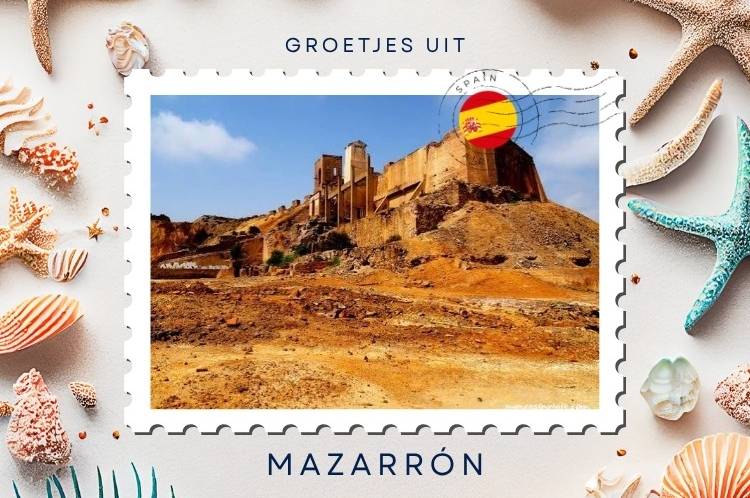
The former mining areas of San Cristóbal and Los Perules provide one of Mazarrón's most unusual landscapes.
Red, orange, yellow and ochre ground surrounds abandoned mining structures and shafts.
Mining experienced another major boom during the second half of the nineteenth century, driven particularly by iron and silver-bearing lead ores.
San Cristóbal-Los Perules, Coto Fortuna and Pedreras Viejas now have protected cultural heritage status.
Visitors should remember that old mining areas can contain unstable ground and open shafts, so this is not somewhere to explore carelessly off established routes.
Historic Mazarrón
The original town contains several buildings linked to the wealth and development created by mining.
These include the Casas Consistoriales, San Andrés Church, San Antonio Church, the Sanctuary of La Purísima and the remains of Los Vélez Castle.
It gives Mazarrón town a character that is easily missed by visitors who head straight to the coast.
Puerto de Mazarrón
Only a short drive away, the atmosphere changes completely.
Puerto de Mazarrón grew around fishing, maritime trade and shipping. Today its beaches, marina, promenade, restaurants and residential neighbourhoods are more immediately visible.
It also remains active throughout the year, making it suitable for both permanent living and second homes.
Phoenician ships beneath the Mediterranean
One of Mazarrón's greatest archaeological stories comes from Playa de la Isla.
Two Phoenician vessels dating to approximately the seventh century BC were discovered here, making the bay enormously important for the study of early Mediterranean shipbuilding and trade.
The Phoenician Ship Interpretation Centre explains the discoveries using audiovisual material, models and a reconstruction of the vessel.
Mazarrón II is no longer underwater
The famous Mazarrón II wreck remained protected on the seabed for decades.
Between September and November 2024, the vessel was carefully recovered in 22 sections and transported to the specialist ARQVAtec laboratory in Cartagena.
Its timbers are now undergoing a lengthy process of conservation and stabilisation before eventual reintegration and display.
In June 2026, ARQVA installed Spain's largest conservation tank of its type specifically to continue the treatment of the wreck.
The original boat therefore cannot currently be visited in Mazarrón, although its remarkable story remains part of the local heritage.
Roman fish production
The Romans also made extensive use of this coastline.
At the Roman Fish-Salting Factory Museum in Puerto de Mazarrón, remains survive from a substantial industrial complex used for processing fish and making preserved products and sauces for trade around the Roman world.
It is a reminder that people were making their living from the sea here long before modern tourism existed.
The strange landscape of Bolnuevo
A short distance west is Bolnuevo.
Immediately behind the beach are the extraordinary Erosiones de Bolnuevo, also known as Las Gredas.
Different layers of sandstone, marl and conglomerate have eroded at different speeds under the influence of wind and water, creating the famous mushroom-like formations.
The formations are protected as a Natural Monument in the Murcia region.
They are one of Mazarrón's most instantly recognisable sights.
Pirates and the Tower of the Horses
Bolnuevo is also home to the Torre de los Caballos, originally part of the coastal defence system against maritime raids.
Local tradition connects the tower with the Miracle of Bolnuevo, when the Virgin of La Purísima was said to have protected the area during a Barbary raid in 1585.
Centuries later, that story is still celebrated.
The Bolnuevo pilgrimage
Every November, the Fiestas del Milagro culminate in the Romería de Bolnuevo.
Thousands gather as the image of the Virgin is taken towards Bolnuevo and the beach. The 2025 celebration again combined religious devotion with a large family and community gathering beside the Mediterranean.
December brings Mazarrón's main patron saint celebrations in honour of La Purísima.
Thirty-five kilometres of coastline
Mazarrón municipality has around 35 kilometres of coast.
Urban beaches around Puerto include Bahía, La Reya, Nares and El Castellar. Beyond Bolnuevo, the coast becomes increasingly natural.
Covaticas, Percheles and other smaller beaches provide a very different experience from the built-up waterfront.
It is easy to discover a different beach every time you head out.
Percheles Beach
Percheles is one of the best-known natural beaches.
Palm trees, sand and limited development create an atmosphere that feels far removed from an urban resort.
The surrounding land also has important environmental, archaeological and landscape protection.
For anyone who values quieter stretches of Mediterranean coastline, it is one of the municipality's highlights.
Mountains behind the sea
The coast is backed by ranges including the Sierra de las Moreras, creating a striking combination of dry mountain scenery and blue Mediterranean water.
The Mazarrón Greenway also starts near the old mining landscape and heads into the Campo de Mazarrón along part of the area's former railway environment.
Walking and cycling therefore offer another way to experience the municipality beyond the beaches.
Diving and water sports
Rocky seabeds, caves and underwater fissures make the bay popular among divers.
Sailing, kayaking, paddleboarding and other water sports are also widely available.
Considering the Phoenician archaeological finds beneath the same waters, there is something particularly appropriate about exploring Mazarrón from below the surface.
Weekend markets
Mazarrón town has its traditional weekly market on Saturdays.
The large Puerto de Mazarrón market is held every Sunday throughout the year and has hundreds of allocated stalls.
For permanent residents, these small weekly routines quickly become part of normal life.
Living in Mazarrón
Living in Mazarrón can mean very different things.
Mazarrón town offers a more Spanish urban environment. Puerto de Mazarrón suits people who want beaches and the promenade close by. Bolnuevo provides a smaller coastal atmosphere, while other residential areas offer different combinations of space and international community.
Property includes apartments, townhouses, detached villas and modern new-build homes. Current Casas Palmeras Costa Cálida listings also include several developments categorised within Mazarrón.
Moving to Mazarrón
For anyone considering moving to Spain, this variety can be useful.
You can choose a more locally Spanish environment or live closer to an established international community, while remaining within the same municipality.
Cartagena and Murcia provide larger-city facilities when required, while the coast and countryside remain part of everyday life.
Buying property in Mazarrón
We would start any Mazarrón property search with the map rather than the house.
Do you mean Mazarrón town, Puerto de Mazarrón, Bolnuevo or another residential area?
Once the location suits your lifestyle, it makes sense to compare property size, orientation, outdoor space, pool, parking and other features.
In a municipality this varied, exact location can make a bigger difference than the property itself.
Why Mazarrón is worth discovering
Start inland, exploring historic Mazarrón and the extraordinary colours of its old mining landscape.
Then head towards Puerto de Mazarrón to discover a bay where Phoenicians and Romans were already trading and processing fish thousands of years ago.
Continue west to Bolnuevo, stop beside its strange rock formations and follow the coastline towards the more natural surroundings of Percheles.
Within one municipality you will have seen mining history, Mediterranean town life, ancient archaeology and remarkably wild stretches of coastline.
Mines, Phoenicians, Romans, Spanish town life and kilometres of Mediterranean beaches.
Greetings from Mazarrón!